

How Low Tire Pressure Impacts Your Drive in Boone, NC

May 18th, 2026 by


It is a scenario every driver in Boone has faced: you’re heading down Highway 421 or navigating the winding turns of the Blue Ridge Parkway when that amber horseshoe-shaped light illuminates on your dashboard. Your first instinct might be to ignore it, thinking you can make it to your destination before addressing the issue. However, at Modern Ford of Boone, we believe that understanding the gravity of tire pressure is fundamental to your safety. Driving on underinflated tires isn’t just a minor inconvenience; it is a significant risk that compromises your vehicle’s structural integrity, handling capabilities, and overall safety profile.

Low tire pressure is often a silent predator. Unlike a flat tire that makes itself known through immediate noise and vibration, underinflation can be subtle. It slowly degrades your car’s performance while you remain unaware of the mounting danger. For residents in the High Country, where elevation changes and sharp curves are the norm, the margin for error is razor-thin. This article serves as your comprehensive guide to understanding why tire pressure matters, the science behind tire failure, and how our team at Modern Ford of Boone can help you stay safe on the road.

 

Immediate Safety Risks: Handling and Braking


When your tires are underinflated, the contact patch—the part of the tire actually touching the pavement—changes shape. Instead of a uniform surface, the tire sags, causing the sidewalls to flex excessively. This leads to a ‘mushy’ steering feel. In Boone, where we frequently deal with steep descents and tight switchbacks, precise steering is not optional; it is a necessity. A tire with low pressure cannot respond as quickly to your steering inputs, which can be the difference between successfully navigating a curve and drifting into another lane.

Furthermore, braking distances are significantly increased when pressure is low. Because the tire is not maintaining its intended shape, it cannot provide the necessary friction and grip required to stop the vehicle effectively. This is especially dangerous during our frequent North Carolina rain showers or the icy mornings common in the High Country. If you find yourself needing to upgrade to a vehicle with more advanced safety features, remember that even the best technology cannot overcome the physics of a poorly maintained tire.


White Ford Expedition SUV driving on scenic road at sunset.

The Science of a Blowout


Why does low pressure lead to a catastrophic failure? It all comes down to heat. As an underinflated tire rolls, the sidewalls flex much more than they were designed to. This constant flexing generates tremendous internal friction, which in turn generates heat. Rubber is a poor conductor of heat, meaning that once the temperature inside the tire structure begins to rise, it stays there.

At high speeds, such as driving on I-77 or the faster sections of US-321, this heat buildup can cause the internal components of the tire—the fabric, steel belts, and rubber—to lose their bond. This is known as heat-induced delamination. Eventually, the structural integrity of the tire fails entirely, resulting in a sudden, violent blowout. Unlike a slow leak, a blowout happens in a fraction of a second, often causing the driver to lose control of the vehicle entirely. Preventing this requires proactive maintenance and regular checks at the parts department at Modern Ford of Boone to ensure your tire components are in top shape.


It’s important to note that the danger increases with the load of the vehicle. If you are hauling equipment for a weekend at Grandfather Mountain or carrying a full load of passengers, the stress on an underinflated tire is magnified. The combination of high weight, high speed, and low pressure is the perfect recipe for a tire failure. We often see drivers who assume that if the tire ‘looks’ full, it must be safe. In reality, modern radial tires can be significantly underinflated (down by 10 or 15 PSI) without showing a visible bulge. This is why manual verification is the only way to be certain of your safety.


Identify the Problem: TPMS vs. Manual Inspection

Understanding TPMS


The Tire Pressure Monitoring System (TPMS) is a vital safety feature mandated in vehicles since 2008. It uses sensors to alert you when pressure drops below a certain threshold. However, most TPMS alerts only trigger when a tire is 25% underinflated. This means you could be driving on significantly low pressure for weeks before the light ever comes on.


The Manual Gauge


A high-quality manual tire pressure gauge is the most reliable tool in your arsenal. We recommend checking your pressure at least once a month and before any long trip. Always check the pressure when the tires are ‘cold’—meaning the car has been parked for at least three hours or driven less than a mile.


Where to Find Specs


Don’t look at the sidewall of the tire for the recommended PSI—that is usually the maximum pressure the tire can hold, not the ideal pressure for your vehicle. Instead, check the placard located on the driver-side door jamb. This provides the specific pressure settings for your vehicle’s make and model.


Professional Tire Inspection at Modern Ford of Boone


Is your TPMS light staying on? Are you noticing a vibration in your steering wheel? Don’t leave your safety to chance. Our factory-trained technicians can perform a comprehensive safety check, including pressure adjustment, tread depth measurement, and inspection for hidden damage. We utilize state-of-the-art diagnostic equipment to ensure your vehicle is road-ready.
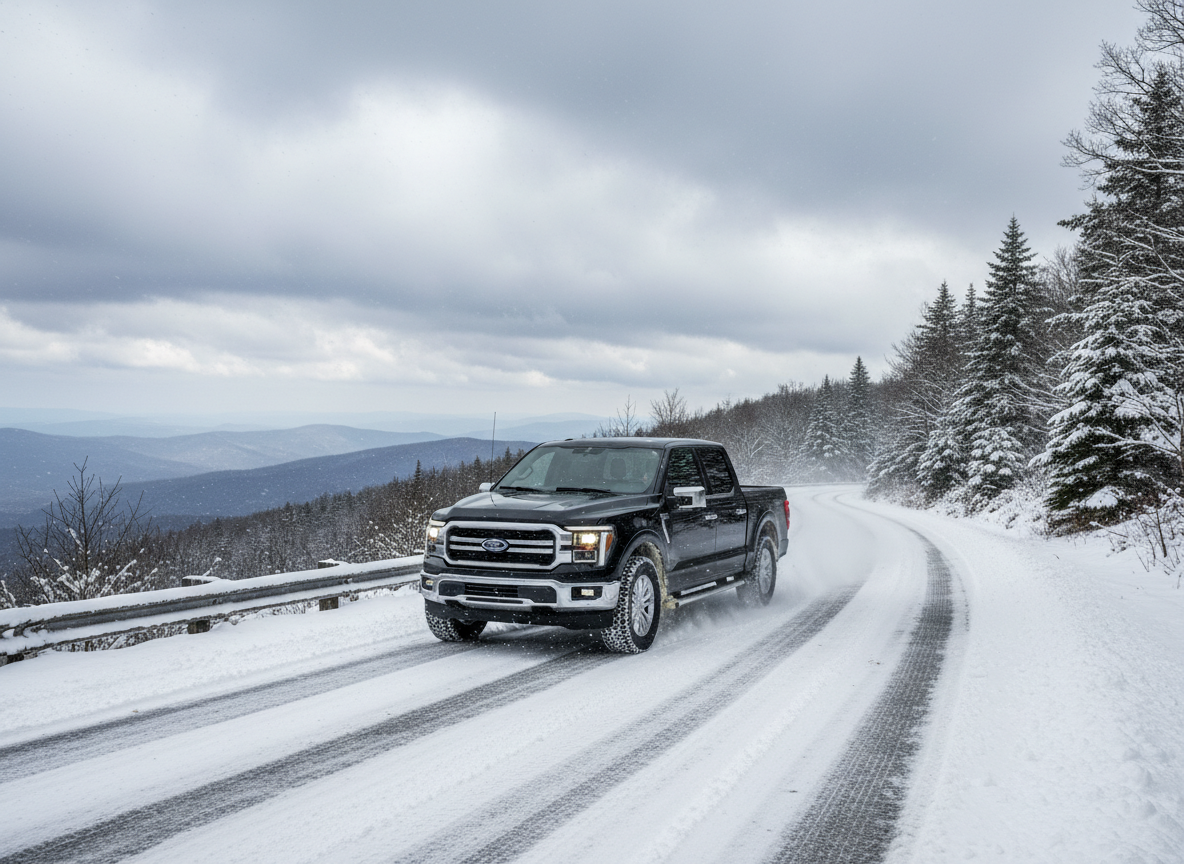
 

Black Ford F-150 pickup truck driving on snow covered road.

The Economic Impact: Fuel Economy and Tread Life


Safety is the primary concern, but the financial impact of low tire pressure is equally significant. Underinflated tires create more ‘rolling resistance.’ Essentially, the engine has to work harder to push the vehicle forward because the tire is dragging across the road surface rather than rolling smoothly. According to the Department of Energy, you can improve your gas mileage by up to 3% by keeping your tires inflated to the proper pressure. In a time of fluctuating gas prices, this is money back in your pocket.

Furthermore, low pressure causes uneven tread wear. When a tire is underinflated, the edges (shoulders) of the tire bear more of the load, causing them to wear out much faster than the center. This prematurely ruins a set of tires that might have otherwise lasted another 10,000 miles. Replacing a full set of tires on a modern SUV or truck can cost over $1,000. Frequent checks are a small price to pay to protect that investment.


Boone Weather and Your Tires


Living in the Blue Ridge Mountains presents unique challenges for vehicle maintenance. Our drastic temperature swings are a major factor in tire pressure loss. Physics dictates that for every 10-degree drop in ambient temperature, your tires will lose approximately 1 PSI (pound per square inch) of pressure.

In Boone, it is not uncommon to see a 30 or 40-degree temperature drop overnight during the transition from fall to winter. This means your tires could easily lose 4 PSI in a single night just from the cold air. This ‘seasonal drop’ is the most common reason why TPMS lights illuminate on the first cold morning of the year. It is crucial to adjust your pressure as the seasons change to maintain safety and performance. If you’re concerned about how your vehicle handles the mountain terrain, consider that we have many used vehicles for sale at Modern Ford of Boone that are specifically vetted for High Country driving conditions.


Temperature Change Estimated PSI Loss
10°F Drop -1 PSI
20°F Drop -2 PSI
30°F Drop -3 PSI
40°F Drop -4 PSI


Common Causes of Pressure Loss

Punctures & Debris


Nails, screws, and sharp rocks can cause ‘slow leaks.’ You might not notice the pressure drop immediately, but over several days, the tire becomes dangerously low.


Faulty Valve Stems


The valve stem is the small rubber tube where you add air. Over time, these can dry out, crack, or leak at the base, allowing air to escape slowly but constantly.


Rim/Bead Damage


Hitting a pothole in Boone can bend your rim, breaking the airtight seal (the bead) between the tire and the wheel. This often requires professional repair.


Equip Your Vehicle for the Road Ahead


Being prepared is the best defense against tire trouble. We carry a full range of high-quality tires specifically designed for the rugged terrain of Watauga County. From all-terrain tires for your Ford F-150 to performance tires for your Explorer, our experts can help you choose the right fit. We also stock professional-grade pressure gauges and portable inflators so you’re never caught off guard.


Step-by-Step: How to Properly Inflate Your Tires


Inflating your tires is a simple task, but doing it correctly is essential for safety. Follow these steps to ensure accuracy:

1. Find your PSI: Locate the tire information placard on your driver-side door jamb. Note the PSI for the front and rear tires (they are sometimes different).
2. Check Cold: Ensure the tires are cool to the touch before measuring.
3. Remove Valve Cap: Unscrew the cap and place it in your pocket or a safe spot—they are easy to lose!
4. Check Current Pressure: Firmly press your pressure gauge onto the valve stem. You should hear a brief hiss, then a reading will appear.
5. Add Air: Use an air compressor (available at most gas stations or our service center). Add air in short bursts, checking the pressure between each.
6. Release Air if Needed: If you overfill, use the small nipple on the back of the tire gauge or a fingernail to press the center pin of the valve stem and release air.
7. Replace Cap: Screw the valve cap back on tightly to keep out dirt and moisture.

If you find yourself constantly needing to add air, it’s time to schedule vehicle service online at Modern Ford of Boone so we can find and fix the underlying leak.
 

Signs Your Tires Need Immediate Replacement


Sometimes, low pressure is just the symptom of a much larger problem. If you notice any of these visual cues, the tire is no longer safe to drive on and must be replaced immediately:

* The ‘Ring of Fire’: A dark, discolored ring around the sidewall of the tire. This indicates the tire was driven while flat or extremely low, and the internal structure has been ground down by the rim.
* Bulges or Bubbles: A protrusion on the sidewall indicates that the internal carcass of the tire has failed, and air is pushing against the outer rubber. These are ‘ticking time bombs’ for blowouts.
* Deep Tread Cracks: Also known as ‘dry rot,’ these cracks indicate the rubber has become brittle and can no longer safely hold pressure.
* Exposed Cords: If you can see metal or fabric wires peeking through the rubber, the tire is in a state of critical failure.


White Ford Bronco Sport on foggy forest road.

Proactive Maintenance: The Modern Ford Strategy

Regular Rotations


Rotating your tires every 5,000 to 7,500 miles ensures that all four tires wear at the same rate, extending the life of the set and allowing for regular inspections by our technicians.


Wheel Alignment


Potholes and rough mountain roads can knock your car out of alignment. A misaligned car drags the tires at an angle, causing rapid and uneven wear that mimics low pressure symptoms.


Monthly Checks


Don’t wait for the TPMS light. Set a recurring reminder on your phone to check your tire pressure manually on the first of every month. It takes five minutes and saves hundreds of dollars.


Expert Answers: Tire Pressure FAQ


Can I drive 10 miles on a flat?
No. Driving even a short distance on a completely flat tire can cause irreparable damage to the wheel rim and the tire’s internal structure. If you have a flat, pull over safely and call for a tow or change to your spare.

Why is my TPMS light flashing?
A solid light means low pressure. A flashing light usually indicates a system error, such as a dead battery in one of the sensors. Visit us to have the system scanned and reset.

Does low pressure affect AWD systems?
Yes! Most modern Ford Intelligent All-Wheel Drive systems rely on all four tires having the same circumference to work properly. If one tire is significantly lower than the others, it spins at a different speed, which can put immense strain on the drivetrain and differentials.

Is nitrogen better than air?
Nitrogen molecules are larger than oxygen molecules, so they leak through the rubber pores more slowly. It also contains less moisture. While not strictly necessary, it can provide more stable pressure over time, especially in Boone’s varying climate.


Visit Modern Ford of Boone for Expert Care


Our dealership is conveniently located at 300 New Market Blvd, Boone, NC 28607. Whether you need a quick pressure check, a tire rotation, or a brand-new set of rubber, our team is here to help you navigate the roads of Watauga County with confidence. Get Directions to Modern Ford of Boone today or call us at (828) 264-6111 to speak with a service advisor.


Posted in Ford Service